How long do New Brunswickers live?
In New Brunswick, a person born today can expect to live about 80 years and 4 months. Across Canada, the average life expectancy at birth is 81 years and 6 months. This means that, on average, New Brunswickers live slightly shorter lives compared to Canadians overall.1
When someone dies before the age of 75, this death is considered premature, or in other words, it happened earlier than expected.
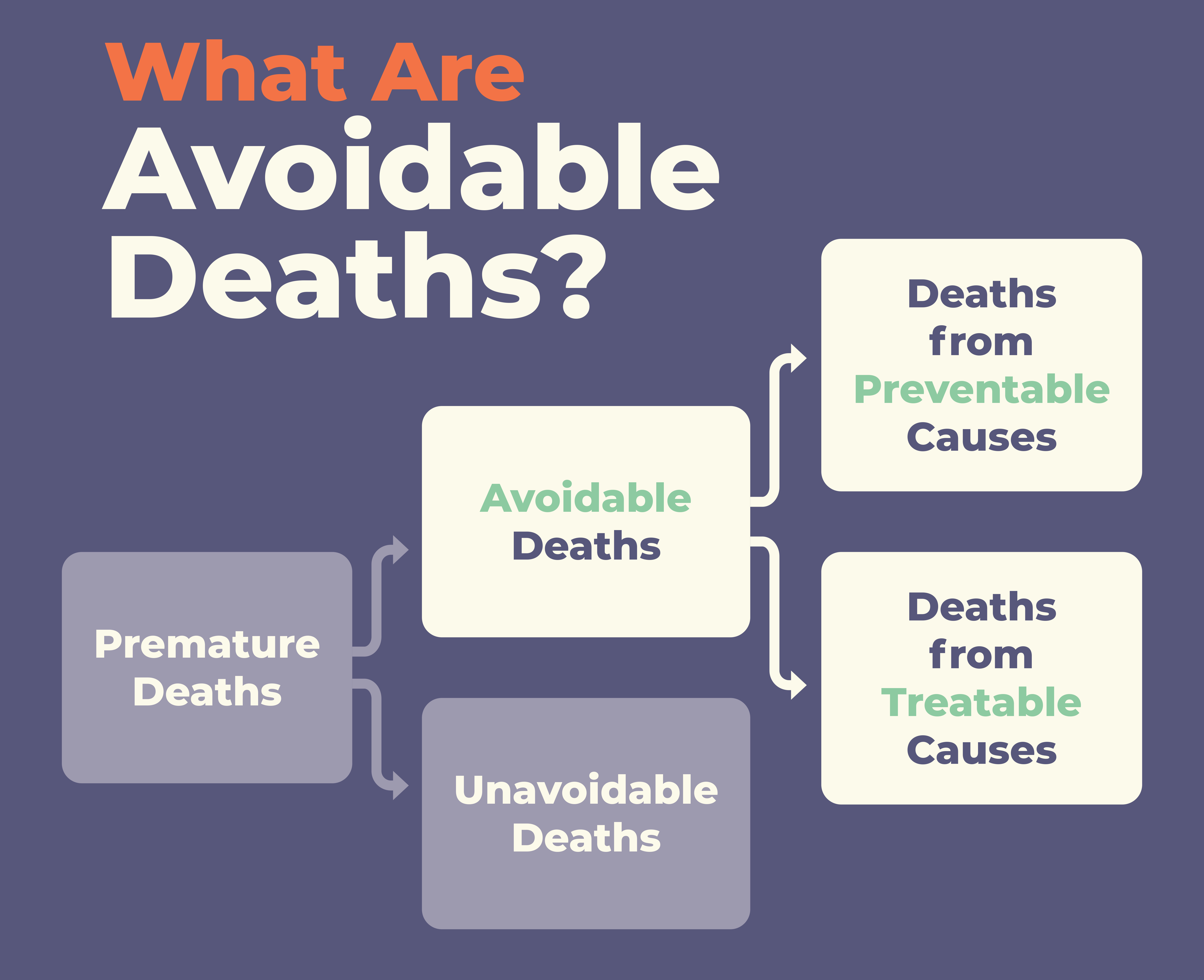
Some premature deaths cannot be avoided. These are considered unavoidable deaths, when nothing could have been done with today’s knowledge in terms of prevention or treatment.
Other premature deaths can be considered avoidable.
These are deaths that could have been avoided, or the person could have lived longer (past the age of 75) with the prevention and care options that exist, such as promotion of healthy lifestyles, early detection of diseases or effective treatments.2
Each year in New Brunswick, around 2,000 individuals die from causes that could potentially have been avoided.3
There are 2 types of potentially avoidable deaths:
- Deaths from preventable causes: deaths that could have been avoided through primary prevention efforts, such as exercising, quitting smoking, wearing a seatbelt, etc.
- Deaths from treatable causes: deaths that could have been avoided or delayed through good quality health care services such as cancer screening, or management of chronic health conditions, treatment of cancer, etc.

Not all regions are the same - while New Brunswick’s overall rate of avoidable deaths is higher than the Canadian average, some zones have lower rates.
New Brunswick compared to Canada:
On average, New Brunswickers live shorter lives than Canadians overall. This shorter life expectancy is a result of higher rates of deaths that could potentially have been avoided, even after accounting for age differences in the population (age-standardization).1,4
Between 2019 and 2021, an average of 202.5 New Brunswickers per 100,000 population died each year from avoidable causes, compared to 193.1 per 100,000 across Canada. The good news is that this gap has been narrowing over the years, as New Brunswick’s rate of avoidable deaths declined from 215.4 per 100,000 in 2015-2017, to 202.5 in 2019-2021.2,4
Between 2019-2021, the rate of deaths from preventable causes was similar in New Brunwick and Canada overall (around 135 deaths per 100,000). However, New Brunwick had a higher rate of deaths from treatable causes (67.3 compared to 60.6 deaths per 100,000 nationally).4
Health Zones compared to New Brunswick and Canada:
Between 2019-2021, the rate of avoidable deaths varied across New Brunswick’s health zones, even after adjusting for age differences.
- Zone 5 (Restigouche Area) had the highest rate, with 272.5 avoidable deaths per 100,000 population.
- Zone 1 (Moncton and South-East Area) and Zone 6 (Bathurst and Acadian Peninsula) had the lowest rates, at 184.1 and 175.6 avoidable deaths per 100,000 population.
If we compare these rates to Canada, Zone 6 had a lower rate of avoidable deaths than the Canadian average of 193.1 per 100,000. 4
A similar pattern is seen for deaths from preventable causes:
- Zone 5 had the highest rate with 192 deaths per 100,000 population.
- Zones 1 and 6 had the lowest rates, with 121.4 and 118.3 deaths per 100,000 population, respectively.
Both Zone 1 and Zone 6 had lower rates of deaths from preventable causes compared to Canada. 4
Every year, about 2,000 New Brunswickers die from causes that could have been avoided. Six causes are behind half of these deaths.
For the years 2018-2022, around 2,000 New Brunswickers died each year from causes that could potentially have been avoided. Six causes, out of a list of 82 causes of avoidable deaths, accounted for about 1,000, or 50% of these deaths.3
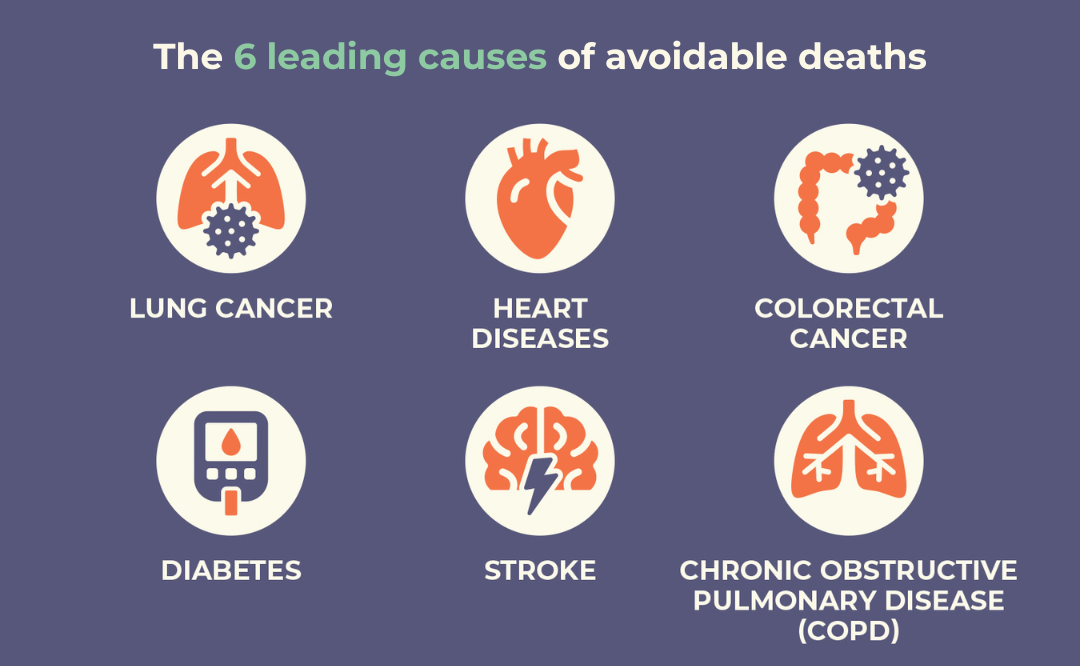
5 out of these 6 causes are highly influenced by prevention efforts, such as lifestyle changes and share common risk factors such as smoking, heavy drinking, physical inactivity and unhealthy diet.
4 out of 6 of these causes are highly influenced by early detection as well as disease management efforts, such as management of hypertension, high cholesterol, unhealthy weights and keeping diabetes in control.
Colorectal cancer is the only one of the 6 causes that is mostly influenced by treatment efforts, which include screening and early detection, and early treatment of the cancer.
Four other causes of avoidable deaths make it to the top 10 in New Brunswick. These are: alcohol-specific disorders (which include a wide range of diseases where alcohol is the leading factor), breast cancer among women, suicide (intentional self-harm), and accidental injuries not related to transportation.
Leading causes of death for each health Zone
The table below shows the top 10 causes of avoidable deaths for each health zone, along with their rates. Note that the rates by cause of death are not age-standardized.3
Consistency across zones:
- The six leading causes of avoidable deaths in New Brunswick are also found among the top 10 causes in every health zone.
- Lung cancer and heart disease consistently rank as the top 2 causes of avoidable deaths across all 7 zones.
- Most health zones share a similar profile of leading causes of death, with 9 out of 10 matching the provincial list.
Differences compared to the provincial picture results:
- Deaths from transport accidents appear in the top 10 causes in Zones 3 and 7.
- Deaths from drug disorders and poisoning appear in the top 10 causes in Zones 1 and 2.
- Deaths from intentional self-harm do not appear among the top 10 causes in Zones 1 and 2.
- Deaths from accidental injuries do not appear among the top 10 in Zones 3 and 5.
- Deaths from breast cancer do not appear among the top 10 causes in Zones 5 and 7.
Zone 5 a distinct profile:
Zone 5 is the only zone where the leading causes of avoidable deaths are somewhat different:
- Deaths from chronic liver disease and deaths from liver cancer appear among the top 10.
- Deaths from intentional self-harm are the 4th leading cause of avoidable death.
Avoidable deaths highlight deeper challenges affecting people’s health.
Why do we measure avoidable deaths?
Avoidable deaths are an important indicator of population health. They reflect outcomes influenced by a range of factors including health behaviours or lifestyle, socio-economic conditions, physical environment, and health services.
Some causes of avoidable death are linked to primary prevention efforts outside the health system, such as road safety measures that can reduce transport-related deaths. Others are more directly linked to access to health services at different stages, from vaccination and screening to disease management and treatment, related to physical or mental health.
Primary health care plays a key role at every stage. Primary care providers interact with people throughout their lives, helping prevent the onset of disease by offering guidance on healthy lifestyle; providing opportunities to detect health problems early, such as cancer screening and diagnosis of other chronic health conditions, and by helping people manage their chronic health conditions.
Finally, broader social determinants of health, such as income, education, or living conditions, also influence a person’s likelihood of developing health problems or benefiting from prevention efforts .

Conclusion:
Avoidable deaths provide valuable insight into population health, revealing regional differences in the factors that influence health outcomes. These deaths reveal deeper, less visible population health issues that may eventually lead to people dying both too soon and from something that could have been avoided.
By definition, avoidable deaths are those for which prevention or treatment efforts could have made a difference throughout a person’s life and reflects the performance of the health system. Primary care providers are key players as they work with people throughout their lives and at every stage of prevention.
With two-thirds of avoidable deaths caused by preventable conditions, there is a clear opportunity to reduce the burden of chronic disease and improve population health through stronger prevention efforts.
Ultimately, understanding the causes of avoidable deaths helps stakeholders plan programs, set priorities, and target resources to areas of greatest need, supporting more effective interventions and healthier communities across New Brunswick.
Note on how we compare numbers: In this article, we compare numbers using confidence intervals. Simply put, these show a range where the true value is likely to be. If the ranges for two numbers do not overlap, we consider the numbers to be meaningfully different, either higher or lower.
Take Action: Screening recommendations and helpful resources for some key risk factors.
➥ Alcohol Consumption: Canada's Guidance on Alcohol and Health | Canadian Centre on Substance Use and Addiction.
➥ Physical Activity: 24-Hour Movement Guidelines – 24-Hour Movement Guidelines.
➥ Smoking: Smoke & Vape Free NB.
➥ Diet: Canada's Food Guide.
➥ Screening: New Brunswick Cancer Network - gnb.ca.
References
- Statistics Canada. Table 13-10-0114-01. Life expectancy and other elements of the complete life table, three-year estimates, Canada, all provinces except Prince Edward Island. 2021–2023. Last accessed November 7, 2025.
- Canadian Institute for Health Information. Avoidable deaths. Accessed November 7, 2025.
- Service New Brunswick, Vital Statistics Database. In-house calculation (2018–2022). Data not age-standardized. 2018–2022.
- Statistics Canada, Canadian Vital Statistics, Death Database and Demography Division (population estimates). Table 13-10-0753-01, age-standardized rate per 100,000 population, 2019–2021.
- Service New Brunswick, Vital Statistics – Annual Statistics 2022. Table 1: Deaths by year and sex, New Brunswick, 1926–2022.
- Canadian Institute for Health Information. List of Conditions for Avoidable Mortality and Mortality from preventable and treatable causes indicators. October 2022.
- New Brunswick Department of Health, Diabetes Registry, 2024–2025.
For the years 2018-2022, around 8,000 New Brunswickers died each year, with avoidable deaths responsible for about one quarter of all deaths.5
Some causes of death are considered to be mostly preventable (e.g., lung cancer or accidents), while others are considered to be mostly treatable (e.g., breast or colorectal cancers). Some causes are considered to be equally influenced by both prevention and treatment efforts (e.g., diabetes or heart diseases).
This classification is based on whether the majority of deaths could be avoided through prevention or through treatment efforts.6
in New Brunswick, 54.5% of registered diabetes patients were in the optimal range of glycemic control (A1c level < 7%) 7
Zone 1 : Moncton and South-East Area
Zone 2: Fundy Shore and Saint John Area
Zone 3: Fredericton and River Valley Area
Zone 4: Madawaska and North-West Area
Zone 5: Restigouche Area
Zone 6: Bathurst and Acadian Peninsula Area
Zone 7: Miramichi Area
Some health zones have developed initiatives that target prevention efforts, such as the “5-2-1-0” (5 fruits& vegetables per day; 2 hours of screen time or less; 1 hour of physical activity per day; 0 sugars) initiative in Zone 7 aimed at improving lifestyles.