


Introduction
Youth health and well-being are influenced by a range of factors that shape their daily lives and their opportunities to live healthy lives. According to the population health model used by the New Brunswick Health Council (NBHC), social and economic factors, health behaviours, health services, and physical environment all contribute to physical and mental health.

These factors are interconnected and influence one another. Policies and programs also play an important role in improving population health.
The New Brunswick Student Wellness and Education Survey measures various health related factors as well as youth health outcomes. Gaining a better understanding of the links between these factors helps identify the realities faced by young people and guide actions aimed at promoting health equity in the province.
The results of the 2025-2026 edition of the survey shed light on important disparities according to youth socioeconomic realities. Here are a few key findings about NB youth health and factors that influence it.
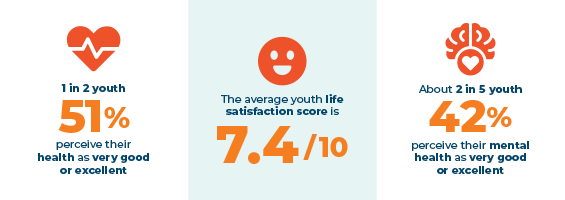
Youth health and well-being remain a concern
For several years, data collected by the NBHC have shown that the health and well-being of students in grades 6 to 12 remains a concern across several key indicators.
Youth experience realities that influence their health and well-being, often in unfavourable ways, but they also benefit from some protective factors
Social relationships have an important role in shaping youth well-being. More specifically, healthy relationships contribute to well-being, while unhealthy relationships or a lack of meaningful social connections are detrimental to it.
Among New Brunswick youth in Grades 6 to 12:
- 1 in 5 youth (20%) reported feeling lonely most or all of the time in the last 12 months
- Nearly 1 in 2 youth (47%) reported being bullied at school in the last 2 months. Experiencing loneliness and bullying are risk factors for mental health challenges.
- 9 in 10 youth (90%) have a high level of school connectedness, which can help youth face certain challenges.
Health behaviours play a key role in youth physical and mental well-being. Some habits can promote health, while others can increase the risk of health challenges in the short or long term.
Among New Brunswick youth in Grades 6 to 12:
- 1 in 4 youth (24%) meet the Canadian guideline of one hour or more per day of moderate to vigorous physical activity.
- Less than 4 in 10 youth (37%) reported eating breakfast daily, while breakfast is essential for learning and supports global health.
- Just over 1 in 10 youth (11%) reported vaping daily or occasionally. Vaping increases the risks of addictions and respiratory problems.
Socioeconomic inequalities and their impact on health
Youth from low socioeconomic backgrounds face greater challenges that affect their physical and mental health.
Socioeconomic status is one of many factors that influence youth health. In general, children and youth from more disadvantaged backgrounds face greater health challenges than average.2-4
Poverty is one of the top 10 threats to childhood in Canada.5 Poverty particularly affects children and youth in New Brunswick.
In 2023, 22% (32,140) of children and youth aged 0 to 17 in New Brunswick were living in poverty. This was the 4th highest rate among the Canadian provinces (compared to the lowest rate of 13% in Quebec and the highest rate of 27% in Saskatchewan and Manitoba).6

To estimate youth socioeconomic status, the NBHC uses the Family Affluence Scale.7 This measure of material wealth comprises six items.8
Health and well-being disparities by socioeconomic status
According to the results of the 2025-2026 edition of the NB Student Wellness and Education Survey, youth in New Brunswick from low socioeconomic backgrounds face greater challenges than the provincial average on some health outcomes, social support and community safety as well as healh behaviours. Alternatively, youth with high socioeconomic status face fewer challenges than the provincial average in some of these areas.
Conclusion
The results presented above demonstrate that New Brunswick youth face numerous challenges related to their health and well-being, while also benefiting from some protective factors, such as school connectedness.
Overall, results are less favourable among youth with a low socioeconomic status. These youths report worse than average results in terms of their health and the factors that influence it.
As stated in the United Nations Convention of the Rights of the Child, each child has the right to an adequate standard of living.9 It is therefore imperative to continue measuring the factors that influence health as well as health results to better understand the population’ needs. Additionally, it appears necessary to put in place politics and programs aimed at reducing socioeconomic inequalities experienced by New Brunswick youth, to allow them to develop their full potential.
To learn more about NB youth health, including health zone, school district, and community level data, visit nbhc.ca/swes
Take action: useful resources
➥ Mental health : Mental health support, Government of New Brunswick
➥ Bullying : PREVNet New Brunswick
➥ Physical activity: Canadian 24-Hour Movement Guidelines
➥ Nutrition: Canada’s food guide: Healthy Eating for Teens
➥ Vaping: Smoke & Vape Free NB
References
- National Collaborating Centre for Determinants of Health (2026). Glossary of Essential Health Equity Terms. Accessed May 27, 2026. https://nccdh.ca/learn/glossary/
- Gautam, L., Dessie, G., Rahmann, M., & Khanam, R. (2023). Socioeconomic status and health behaviour in children and adolescents: a systematic literature review. Frontiers in Public Health, 11 https://doi.org/10.3389/fpubh.2023.1228632
- Hammami N, Da Silva MA, Elgar FJ. (2022). Trends in gender and socioeconomic inequalities in adolescent health over 16 years (2002-2018): findings from the Canadian Health Behaviour in School-aged Children (HBSC) study. Health Promotion and Chronic Disease Prevention in Canada, 42 (2):77-88. https://doi.org/10.24095/hpcdp.42.2.03
- Wu, Y., Zeng, X., Zhou, Z., & Wu, S. (2026). Global Trends in Adolescent Health Inequalities and Their Social Determinants: A Bibliometric and Scoping Review. Healthcare, 14(2), 141. https://doi.org/10.3390/healthcare14020141
- Children First Canada (2025). Top 10 Threats to Childhood in Canada. https://childrenfirstcanada.org/campaign/raising-canada/
- Statistics Canada. Table 11-10-0018-01 After-tax low income status of tax filers and dependants based on Census Family Low Income Measure (CFLIM-AT), by family type and family type composition
- Currie C, Alemán Díaz AY, Bosáková L, de Looze M. (2024). The international Family Affluence Scale (FAS): Charting 25 years of indicator development, evidence produced, and policy impact on adolescent health inequalities. SSM Popul Health. https://doi.org/10.1016/j.ssmph.2023.101599
- Inchley J, Currie D, Samdal O, Jåstad A, Cosma A & Nic Gabhainn S, editors. (2023). Health Behaviour in School-aged Children (HBSC) Study Protocol: background, methodology and mandatory items for the 2021/22 survey. Glasgow: MRC/CSO Social and Public Health Sciences Unit, University of Glasgow.
- Unicef Canada (2023). Child Poverty in Canada : Let’s Finish This. UNICEF REPORT CARD 18 Canadian Companion. https://www.unicef.ca/sites/default/files/2023-12/UNICEFReportCard18CanadianCompanion.pdf