

At the New Brunswick Health Council (NBHC), our role is to measure, monitor and inform citizens on the performance of the health care system. Over the years, the NBHC has used both survey results and information collected by the healthcare system (administrative data) to report on primary care performance.
Since 2022, the NBHC has published annual results from its Primary Care Survey on topics such as having a primary care provider, timely access, and citizens’ experiences with primary care.
In 2025, several key observations emerged regarding primary care in New Brunswick, based on findings from the 2025 Primary Care Survey and administrative data:
In 2025, 73% of citizens in New Brunswick reported having a permanent primary care provider (PPCP), a decline from 2024
In 2025, there has been a decline in the percentage of citizens who reported having a primary care provider, going from 77% in 2024 to 73% in 2025. This decline was mostly pronounced in Zone 3 (from 63% to 56%) and Zone 7 (from 83% to 72%).
Percentage of Citizens with a Primary Care Provider by Zone
* Highlighted zones show a lower percentage than in 2024, based on a comparison of confidence intervals.
In terms of geographic variability for 2025, Zones 1 and 2 had a higher percentage of citizens who reported having a primary care provider compared to NB at 81% and 78% respectively. Zone 3 had a lower percentage of citizens who reported having a primary care provider at 56%.
While services like NB Health Link are intended to help bridge this gap, by providing temporary attachment to a primary care provider, awareness about this program remains limited among citizens who do not have a primary care provider. According to the results of the Primary Care Survey in 2025, around half of the citizens who do not have a primary care provider were registered with NB Health Link. The majority of the other half (those not registered with NB Health Link) did not hear about the program before.
Demand and supply in primary care
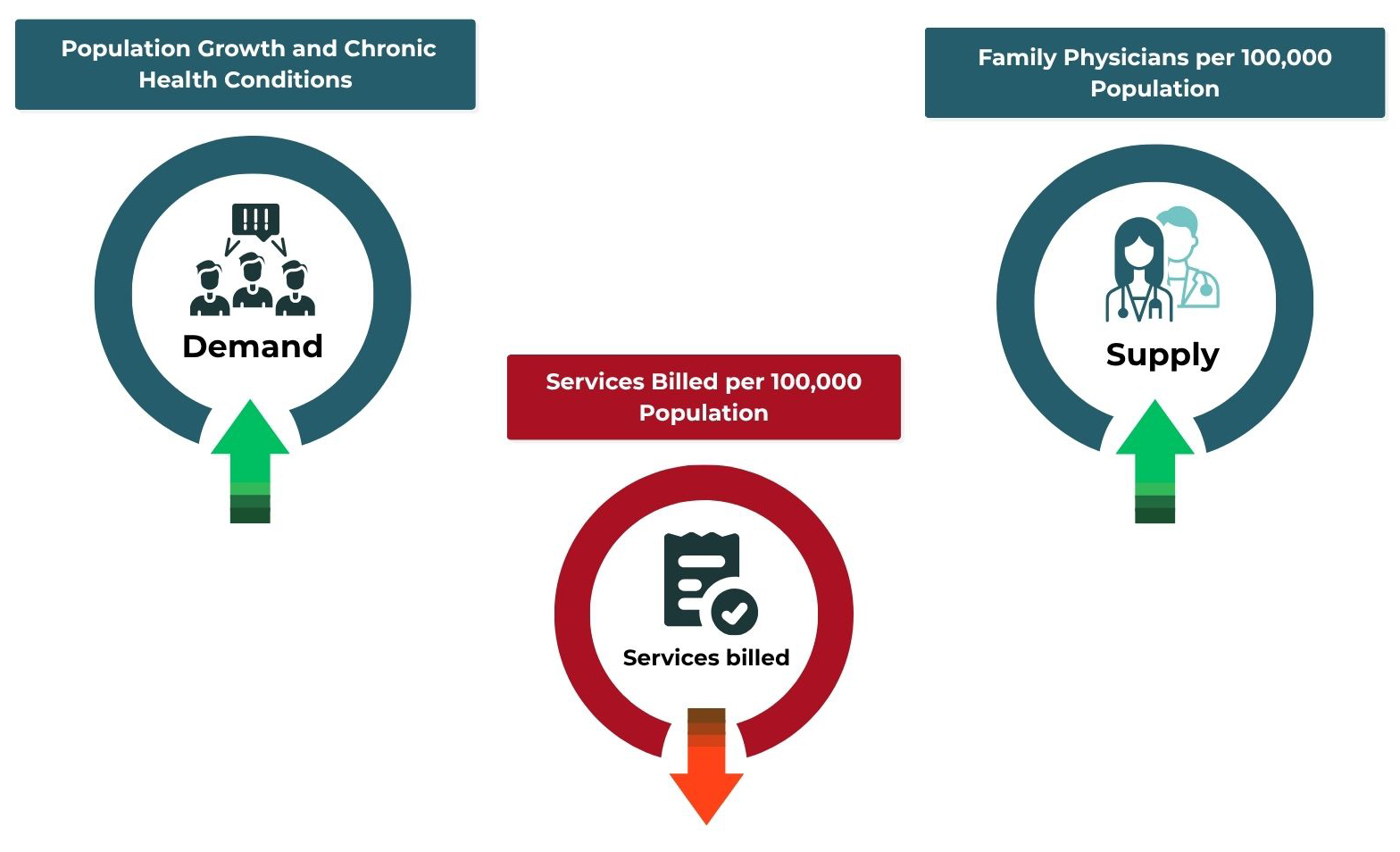
Access to a primary care provider can potentially be influenced by both demand (how many people need care) and supply (how many services are available).
On the demand side, more New Brunswickers are seeking primary care services because the population is growing and more people are living with chronic health conditions that require ongoing and more complex care.
On the supply side, administrative data shows that New Brunswick has a higher rate of family physicians per 100,000 population compared to the Canadian average, even after a slight decrease in 2024 (142 per 100,000 population in 2023 to 138 per 100,000 population in 2024)2.
However, having more doctors does not necessarily translate into more services provided. Administrative data shows that the number of billed services provided per 100,000 population such as check-ups, tests, and procedures have decreased since 2019, from around 380,000 billed services per 100,000 population in 2019-2020 to around 318,000 billed services per 100,000 population in 2023-20244. This suggests that, overall, fewer services are being delivered per person, despite the increase in the number of physicians.
Timely access hasn’t changed: Since 2022, just 1 in 3 citizens reported being able to get an appointment with their primary care provider within five days
In 2025, 34% of citizens reported that they were able to get an appointment with their primary care provider within five days. In Zone 6, this was higher at 48%.
When patients cannot see their primary care provider in a timely manner or do not have one, they turn to other services, such as emergency departments. In 2024-2025, administrative data showed that around 52% of emergency department visits were for non-urgent care (Classified as triage levels 4 and 5) and this percentage has not changed since 2019-2020. This was even higher in Zone 4 where 64% of visits were for non-urgent care in 2024-20255.
Citizens’ experiences with primary care have not improved over the past three years
In addition to having a primary care provider and being able to see them within five days, the experience of citizens with those interactions also matters.
In 2025, about 2 out of 3 citizens reported that their primary care provider:
↪ Explained things in a way that they could understand, always
↪ Involved them in decisions about their health care, always
↪ Provided needed support, definitely
In terms of satisfaction, 85% of citizens were somewhat or very satisfied with the care received from their primary care provider, but only 1 in 2 reported that their primary care provider spent enough time with them and helped them coordinate care from other health care providers and places.
These results have remained unchanged since 2023, showing no improvement in patients’ experiences over the past three years.
Table 1: Percentage of citizens reporting good care experience with their permanent primary care provider (PPCP) in the last 12 months in NB -2023, 2024 and 2025
Equity in care: Some demographic groups report a lower percentage of attachment to and good care experience with their primary care provider
Compared to the provincial average of 73%, the following demographic groups reported lower attachment to a primary care provider:
Citizens aged 18 to 64
(69%)

Citizens who report an annual income of less than $30,000
(63%)

Citizens who identify as immigrants
(42%)

Citizens who identify as part of a racialized group
(44%)

Compared to the provincial average, the following demographic groups reported lower percentage for having a good experience with their primary care provider, as shown in Table 2 below.
These include:
- Citizens who identify as immigrants
- Citizens who identify as part of a racialized group
- Citizens who identify as members of the 2SLGBTQIA+ community
- Citizens who reported an annual income of less than $30,000.
Language also plays a role : A lower percentage of people who are most comfortable receiving care in French reported a good experience with their primary care provider compared to the provincial average. In contrast, those most comfortable in English, or comfortable in both official languages, reported experiences similar to the New Brunswick average.
Table 2: Percentage of citizens reporting a good experience with their PPCP in the province and by demographic group in 2025
* Percentages in red are worse than the NB average and those in green are better than the NB average.
Conclusion
The percentage of citizens who reported having a permanent primary care provider decreased in 2025. At the same time, the percentage of citizens who reported timely access to their primary care provider and a good experience with their primary care provider have remained unchanged for the past 3 years. These outcomes are not consistent across the population, with some demographic groups reporting lower percentage of attachment and positive experiences with care.
The NB Government is making significant investments aimed at increasing the percentage of citizens who have a primary care provider and improving timely access6. The 2026 physician service agreement between the government and the Medical Society in New Brunswick also focuses on primary care and provides incentives to family physicians to improve attachment, timely access and develop collaborative clinics that integrate interdisciplinary teams, with nursing and allied professionals working alongside family doctors.
Considering these ongoing developments and investments happening in primary care, the NBHC will continue to monitor key indicators about the primary care sector, to assess whether these efforts are leading to better outcomes for citizens.
References
- Statistics Canada, Administrative data. Accessed on May 29, 2025.
- Canadian Institute for Health Information. Supply, Distribution and Migration of Physicians in Canada, 2001 to 2024 — Historical Data. Ottawa, ON: CIHI; 2025.
- New Brunswick Department of Health, Office of the Premier Release, Government provides update on health-care system: Progress reported in areas related to workforce and primary care. April 29, 2026: Government provides update on health-care system - gnb.ca.
- Canadian Institute for Health Information. National Physician Database Historical Utilization, 2014–2015 to 2023–2024 — Data Tables. Ottawa, ON: CIHI; 2025.
- New Brunswick Department of Health, Annual Report of Hospital Services 2019-2020 to 2024-2025.
- Government of New Brunswick, 2026-2027 Budget. Budget - gnb.ca.